RentRedi for Tenants & Owners
- 4.4
- Rating
- 100.00K
- Installs
- Free
- Price

 Analysis by App-foxy
Renting usually becomes difficult in the gaps between people: a tenant sends a message, an owner checks a bank account, a repair gets discussed in another app, and everyone later tries to remember what happened. RentRedi for Tenants & Owners takes a more focused approach by putting the rental relationship in one place. After spending time with it, my view is simple: it is most useful when both sides are willing to use the same rental workspace, but it is less convincing as a complete replacement for every tool a property owner may already need.
Developed by RentRedi Inc, this free House & Home app is designed for the everyday business of renting rather than for browsing properties or decorating a room. Its store summary, “Make Renting Easy,” is a fair description of the goal, although the experience depends heavily on how consistently landlords and tenants keep information inside the app. It is available to an Everyone audience, runs on Android versions from 5.0 onward, and has built a sizable user base with over one hundred thousand installs. The current version is 6.560.
How RentRedi fits into real rental life
I look at RentRedi through the daily handoffs that make renting run smoothly: who reports a problem, where routine questions go, and how both sides keep a usable record. In this section, I’ll focus on the practical habits that help a shared rental workspace earn its place, rather than treating installation alone as the solution.
You May Also Like

 Blood Strike: 2.5 Anniversary
Blood Strike’s Loadouts Turn Every Drop Into a Tactical Gamble
A close look at Blood Strike’s custom loadouts: how fast access to signature weapons reshapes its battle royale rhythm, rewards preparation, and narrows the gap between fights.

 Pandora - Music & Podcasts
Pandora’s Music Is Easy to Start, but Harder to Recover
Pandora’s strength is its low-effort path from a seed to a station. Its weak spot is how much confidence it asks you to place in connection, setup, and quiet recovery.

 8 Ball Pool
 Is Built on Rivalries, Rematches, and Routine
A close look at the rivalries, rematches, shared routines, and unanswered safety questions that turn a quick pool match into a persistent mobile community.

 Samsung Music
’s Quiet Strength Is Playing What You Already Own
Its reach comes less from spectacle than from dependable access to a personal library. That simplicity is both the app’s strongest retention engine and its ceiling.

 AccuWeather: Weather Radar
AccuWeather Review: A Quick, Clear Forecast for Everyday Decisions
For everyday plans, the best forecast is the one you can understand quickly. AccuWeather makes rain timing, radar, and local conditions easy to act on, with a few trade-offs.

 Hill Climb Racing
Why Hill Climb Racing Still Turns Crashes Into One More Run
A tiny car, a bumpy hill and one more upgrade: Hill Climb Racing keeps resurfacing because its simple chaos makes every near-miss feel personal.
More From Our News Desk
View All News


A shared place for the landlord and tenant relationship
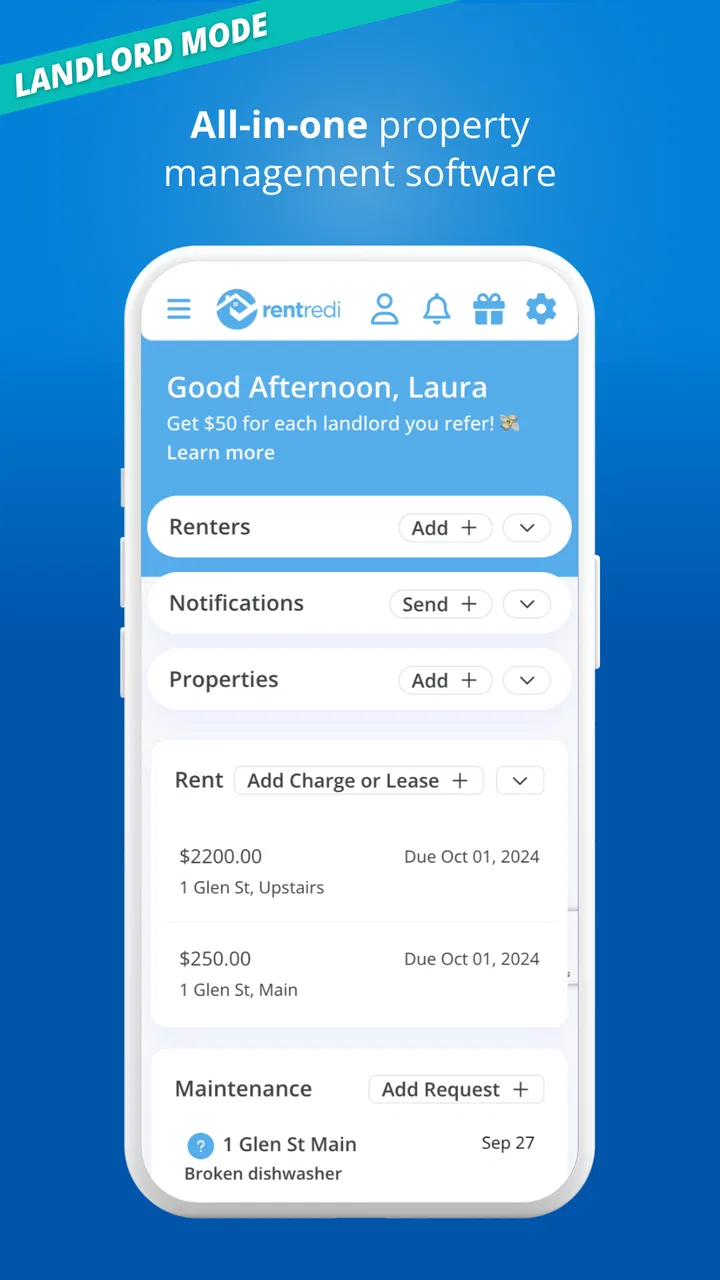
The most important thing to understand is that RentRedi is not simply a rent calculator or a tenant-only organizer. It is built around two connected roles: the person renting out a property and the person living in it. That makes the app more practical than a general notes app when both parties want a consistent record of rental activity.
From a tenant’s point of view, the appeal is convenience. Instead of wondering whether a payment instruction, maintenance request, or landlord message was sent through text, email, or a paper notice, the rental app gives the relationship a more obvious home. That can reduce the small misunderstandings that become surprisingly stressful when money or repairs are involved.
For an owner, the benefit is organization. A landlord managing one property may be able to survive with email, spreadsheets, and a banking app. Once several tenants or units are involved, that arrangement becomes harder to maintain. RentRedi is aimed at making those recurring interactions easier to track without forcing the owner to build a private system from scratch.
I also like that the app speaks to both sides of the arrangement. Many rental tools are designed primarily for property managers, leaving tenants with a thin payment screen. RentRedi’s tenant-and-owner positioning makes the communication problem part of the product rather than treating it as an afterthought.
Why a shared workflow matters more than the download itself
The app is not especially valuable if only one person uses it. A tenant can install it, but the experience becomes much more useful when the owner has set up the rental relationship and continues to use the same channel. That is an important practical trade-off before downloading: this is a coordination tool, not a private dashboard that can independently solve a rental problem.
In a realistic situation, imagine a tenant noticing a leaking kitchen tap on a weekday evening. With a scattered system, the tenant might send a text, follow up by email, and later call because there is no clear place to see whether the request was received. With RentRedi, the intended workflow is more orderly: the tenant can use the rental app to raise the issue, the owner can review it in the same environment, and both have a clearer reference point than a disappearing chat thread.
That does not guarantee a fast repair. The app cannot make an unresponsive landlord respond or turn a serious plumbing problem into a minor one. Its real contribution is reducing uncertainty about the administrative side of the request. I consider that a meaningful strength, especially for people who are tired of searching through old messages.
Where it feels stronger than the usual alternatives
The common alternative for a small landlord is a mixture of bank transfers, text messages, email, calendar reminders, and a spreadsheet. That combination can work, but it puts the burden of organization on the owner. A tenant may also have to remember separate instructions for paying rent, reporting a problem, and asking a question.
RentRedi is more coherent because it is built around renting rather than adapting a general-purpose tool to renting. That distinction matters. A spreadsheet can record an amount, but it does not naturally represent the relationship between a tenant, a property, a payment task, and a maintenance conversation. Email can preserve a conversation, but it is not designed to make rental actions easy to find later.
Compared with a large property-management platform, the app may feel more approachable for an individual owner or a small portfolio. A full platform can offer deeper reporting and more elaborate administration, but it may also introduce more screens, setup work, and terminology than a small landlord wants. RentRedi’s strongest position is in the middle: more structured than informal tools, but potentially less intimidating than enterprise-style property software.
That middle ground is also its limitation. An owner with complicated accounting, extensive compliance processes, or a large team may eventually need a more specialized system. RentRedi can help organize the rental relationship, but I would not choose it solely because it sounds like a universal replacement for every property-management workflow.
The details that make the app more useful in practice
One useful habit is to treat the app as a running rental record instead of opening it only when something goes wrong. If a tenant uses it consistently for routine questions and property issues, the history becomes more valuable over time. The advantage is not one dramatic feature; it is the accumulation of small, relevant interactions in the place where the rental relationship already lives.
A second practical insight is to separate urgent problems from ordinary maintenance communication. A digital request is helpful for tracking a loose cabinet hinge or a non-critical appliance issue, but it should not be the only action for a dangerous leak, fire risk, loss of heat in severe weather, or another emergency. In those cases, the tenant should follow the landlord’s emergency instructions and contact the appropriate service directly. RentRedi can support the record afterward, but it should not be mistaken for emergency response.
A third is to agree on expectations before relying on the app. Tenants should know whether their owner wants all maintenance requests submitted there, and owners should make clear how quickly they normally review messages. Without that agreement, a tenant may assume that submitting a request means someone is actively monitoring it, while the owner may see the app as an occasional administrative tool. The software cannot resolve that communication gap by itself.
For owners, I would also recommend using a consistent naming and description style when managing more than one property. Clear details make later conversations easier to follow, particularly when several similar fixtures or rooms are involved. This is a simple workflow improvement, but it is the kind of discipline that determines whether a rental app feels organized or merely becomes another inbox.
The tenant experience: useful, but dependent on the owner
Tenants who want a straightforward way to interact with a landlord are the most obvious beneficiaries. The app can make rental tasks feel less scattered, especially for people who dislike sending sensitive or important information through casual messaging. Having a dedicated rental environment also makes it easier to distinguish household administration from ordinary personal conversations.
However, the tenant experience is not fully under the tenant’s control. If the owner does not use the platform consistently, the app cannot create a complete record of the tenancy. A renter who is choosing a tool independently may get more immediate value from a personal calendar, a document folder, and a reliable email archive, because those tools do not require the landlord to participate.
That is why I would not describe RentRedi as essential for every renter. It is a good fit when the property owner has adopted it as part of the rental process. It is a weaker choice when the tenant is simply looking for a private place to store lease details or remember payment dates.
The owner experience: organization without automatic discipline
For a small landlord, the app’s main promise is less about replacing judgment and more about reducing administrative friction. A person who owns a rental property but does not want to assemble a system from multiple unrelated apps may appreciate having a rental-specific workspace. It can encourage more consistent handling of tenant interactions and make the relationship feel less improvised.
Still, an owner should not expect automation to replace good management habits. Important documents, financial records, and legal obligations may require careful handling outside the app as well. The right approach is to use RentRedi as part of a process: keep rental communication organized there, maintain appropriate records elsewhere when necessary, and never assume that an app alone satisfies local legal or accounting responsibilities.
This is also where the app may feel less suitable for a professional property operation. If multiple employees need detailed permissions, advanced financial analysis, or a broad operational dashboard, a more comprehensive property-management service may be a better investment. RentRedi makes more sense for owners who value a focused tenant relationship workflow than for teams seeking a deeply customized back office.
What the rating and maturity suggest
RentRedi has been available since May 8, 2017, which gives it more maturity than a brand-new rental experiment. Its average rating is 4.3 from around 4.2 thousand ratings, with roughly 1.1 thousand written reviews. Those figures suggest that many users find the app useful, while also reminding me not to treat it as universally perfect. Rental arrangements vary widely, so an app can work well for one landlord-tenant pairing and feel limited in another.
The free price is another reason it is easy to test, particularly for a tenant who has been invited to use it or a small owner who wants to simplify a basic process. Free does not mean frictionless, though. The real cost may be the time needed to get both sides aligned, transfer habits from existing tools, and decide which records belong in the app and which should remain elsewhere.
Who should use it and who should look elsewhere
I would recommend RentRedi first to individual landlords, small property owners, and tenants whose landlords already use the platform. It is especially suitable for people who want rental communication to be more structured than text messages but do not need an elaborate corporate property system. The shared nature of the app is a genuine advantage for this audience.
It may also suit a landlord who is growing beyond one informal arrangement but is not ready for a heavyweight management suite. In that situation, the app can provide a clearer starting point for recurring rental tasks. The owner still needs sound processes, but the software can make those processes easier to follow.
I would be more cautious if you are a tenant whose landlord refuses to use the app, because the benefits will be limited. I would also look elsewhere if you manage a large operation requiring complex accounting, detailed staff controls, or specialized reporting. A general communication app may be better for a private tenant diary, while a full property-management platform may be better for a professional team.
My final assessment of RentRedi
My overall impression is that RentRedi succeeds when it stays close to its central job: bringing tenants and owners into a clearer rental workflow. It is more purposeful than trying to force spreadsheets, email, and text messages to act like a property-management system. The free entry point, long availability, and focus on both sides of the rental relationship make it worth considering for small-scale renting.
Its weakness is equally clear: the app cannot create cooperation where none exists. A tenant still needs a responsive owner, and an owner still needs reliable habits. It also should not be treated as a substitute for emergency services, legal advice, careful financial records, or a more advanced platform when a property business becomes complex.
For the right arrangement, I would recommend RentRedi for Tenants & Owners as a practical way to reduce rental clutter. I would not install it expecting a magic solution to every property problem. Think of it as a shared administrative home: valuable when both sides move in and use it consistently, but only modestly helpful when it is left sitting on one person’s phone.
That balanced role is why RentRedi earns my recommendation for small landlords and participating tenants rather than for everyone. If your current rental process is spread across too many messages and reminders, it is a sensible app to try. If your needs are highly specialized or your landlord will not participate, another tool may serve you better.
FAQs for RentRedi for Tenants & Owners
01What is RentRedi and how does it benefit both tenants and landlords?
RentRedi is a comprehensive property management app designed to streamline the rental process for both tenants and landlords. For landlords, it offers features like tenant screening, rent collection, and maintenance tracking. Tenants benefit from easy rent payments, maintenance request submissions, and communication tools, making the rental experience more efficient and transparent.
02Is RentRedi secure for handling sensitive information?
Yes, RentRedi prioritizes security by using encryption to protect sensitive information such as personal data and payment details. The app complies with industry standards to ensure that both landlords and tenants can trust their information is safe when using the platform for transactions and communication.
03What devices are compatible with RentRedi?
RentRedi is available on both Android and iOS platforms, making it accessible on a wide variety of smartphones and tablets. Additionally, it can be accessed via a web browser, ensuring users can manage their rental properties or tenancies from any device with internet access, offering flexibility and convenience.
04How does RentRedi handle maintenance requests?
Tenants can submit maintenance requests directly through the RentRedi app, including photos and detailed descriptions to ensure clarity. Landlords receive notifications of these requests and can track progress, assign tasks to maintenance staff, and communicate directly with tenants, ensuring issues are resolved efficiently.
05Is there a fee for using RentRedi, and what does it include?
RentRedi offers subscription-based pricing with different plans to suit various needs. The subscription includes features like tenant screening, automated rent reminders, and unlimited properties and tenants. Users can choose the plan that best fits their requirements, providing flexibility and value for both small and large-scale landlords.
Pros
- User-friendly interface simplifies onboarding.
- Real-time maintenance request tracking.
- Secure payment options enhance trust.
- Customizable notifications for updates.
- Cross-platform support ensures accessibility.
Cons
- Limited offline functionality can be inconvenient.
- Occasional sync issues with bank accounts.
- Some features locked behind paywall.
- Basic analytics tools for property management.
- Customer support response can be slow.

RentRedi for Tenants & Owners
Gallery